







Hana Skálová
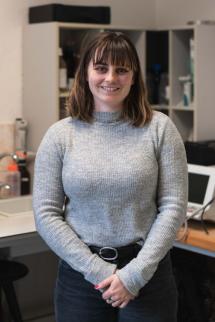 Tell us about yourself:
I come from the Šumava region, and I only discovered my love of chemistry at university, in my very first Inorganic Chemistry lab class. From then on I knew this was exactly what I wanted to do and that I would never stop enjoying it. Throughout my studies I have stayed loyal to the Faculty of Environmental Technology, where I completed the bachelor’s programme Forensic Analysis and then ran off to the master’s programme Technology for Environmental Protection, specialising in Power Engineering, which I still work in today. I continued with doctoral studies, which are still ongoing, and I also work in power engineering in my current job. My research focuses on ion-exchange technologies in power systems and their possible modification for specific operating conditions.
What do you enjoy most about being a scientist?
Science and research are a kind of learning through play, where creativity comes into its own in the search for new possibilities. I’m always learning something new, so I’m rarely bored. I’ve learned to look at problems positively and to look for more than one solution. I enjoy talking to colleagues, who always give me a different perspective. The opportunity to learn from more experienced colleagues and work on international projects is great for both personal and professional development.
What do you consider your greatest achievements so far?
So far, writing and defending my master’s thesis – hopefully another thesis will follow soon! I’ve learned to present to a wider audience and not to be afraid to debate various scientific topics. Also, that I’ve been able to pass on some of my knowledge and enthusiasm for chemistry to other students. For me, the biggest achievement is that even though I sometimes don’t enjoy it as much any more, I’m still here and I haven’t given up.
Why did you choose research over industry?
I enjoyed the topic I was working on and saw an opportunity to continue with it. I didn’t want to give up this creative work, and my previous work in the field felt very routine to me – that kind of work won’t run away. I liked the flexibility of research work, which you set up yourself, and the opportunity to travel or work abroad.
What would you say to those considering a PhD at UCT Prague?
Treat it as a job rather than as a continuation of your studies, because a PhD is very demanding. You do keep learning during a PhD, but it’s very much about your own willpower and perseverance. The first year is very hectic and the following years are no walk in the park either, but you’ll learn to find your way and it will get easier. I recommend thinking it through carefully and discussing in detail with your supervisor how you both see it and how your PhD could go.
What skills do you consider key to success in a research career?
Perseverance and humility towards science. Not despairing over the first failures or slow first steps.