







Jan Vališ
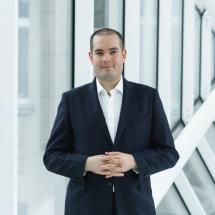 Tell us about yourself:
I am a PhD student at the Department of Analytical Chemistry (Faculty of Chemical Engineering), where, like most PhD students at UCT Prague, I also completed my undergraduate studies. My research sits between spectroscopy, signal processing, machine learning and medicine – I develop diagnostic methods based on vibrational spectroscopy.
Besides research and teaching, which I still enjoy enormously after all these years, I am also part of the Electronic Doctoral Signpost (ERD), the Academic Senate of the Faculty of Chemical Engineering and the Data Stewardship Support team at UCT Prague. Thanks to ERD and the Faculty Senate, my colleagues and I have the chance to positively influence what happens at the university and help make it a good place to live, study and work. As a faculty data steward, I can support researchers in meeting funders’ requirements and good practice.
As if that weren’t enough, I also work on research data management and open science at the National Library of Technology (NTK) within the NCIP project, which is great because this position brings me into contact with a wide range of people and broadens my horizons beyond chemistry. And I’ve always enjoyed helping and advising people – here they even pay me for it, so what’s not to like.
What do you enjoy most about being a scientist?
Apart from the idea that it might one day be beneficial, I enjoy how varied and multifaceted research is. Of course there is sometimes something a bit more monotonous, but otherwise it is a diverse activity – and my ADHD likes that.
Besides bibliometric successes such as publications in Q1 journals, I consider it an exceptional achievement that I received not one but two awards for the best talk at the 24th Interdisciplinary Meeting of Young Scientists in Milovy (once from the audience and once from the expert jury). I got fairly used to presentation awards during my undergraduate studies, but there was always “only” one award per presentation.
What do you consider your greatest achievements so far?
Another equally important achievement is that this year, together with fellow PhD students, I organised the second International Doctoral Conference on Advances in Chemistry. It’s great that the university supports us – it is an invaluable school of management skills, and you meet many interesting people along the way. It sounds a bit like a cliché, but how else would you end up in an international team of authors currently submitting a review to a Q1 journal?
Last but not least, I was recently recognised by the national data steward community, which I really appreciate.
Why did you choose research over industry?
When I applied for my PhD, research was honestly just one of my motivations – I liked the varied nature of the academic profession as a whole and a certain freedom that I probably wouldn’t find as easily in a corporation as at a university. I liked that I would have the opportunity to teach and keep learning new things, not just endlessly practise something I had already learned. And that magic is still there after four years.
What would you say to those considering a PhD at UCT Prague?
Think it over – if you know you enjoy research, teaching, or any combination of the two, go for it. It may be hard work, but with a good supervisor it will be fine, and at the end there will be the degree, with a chance to continue in research. But if you’re doing it purely for the title, or if you don’t choose your supervisor carefully, it will be a long four years.
What led you to take on the role of Data Steward alongside your research – and if you could change one thing about how Czech scientists handle data, what would it be?
As is often the case, it was actually a coincidence. In 2021/22, when a Data Stewardship course was being piloted at UCT Prague, I thought that since I work with data, it wouldn’t hurt to learn a bit more. During the course I realised that this was a fairly new field, and because it was new for practically everyone in the Czech Republic, I joined the Data Stewardship Support team led by Martin Schätz, who, together with his colleague Georgina Koutentaki, trained and mentored me brilliantly and opened up this second, parallel career path for me. My background in analytical chemistry also came in handy – UCT Prague inherently produces a large amount of analytical data.
As for change, I would probably say that researchers shouldn’t be so afraid. The term research data management sounds like a bogeyman, but in reality researchers were often already following many of the good practices long before they were given a modern name. And the little that is new, typically data sharing, is actually not as revolutionary as some people think – in many fields it has been common for several decades, and even in chemistry, making data available on request was standard practice.