







Matěj Malý
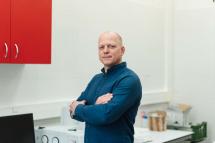 Tell us about yourself:
At secondary school – the bilingual Czech-French Jan Neruda Grammar School in Prague – I enjoyed and was interested in chemistry from the start, even though I was never among the best in terms of grades. I studied it in French and according to the French curriculum, which places particular emphasis on linking physics and chemistry and on applying mathematical thinking. That’s also why UCT Prague was my first and only choice. I completed the bachelor’s programme Food Chemistry and Analysis at UCT Prague in three years and went straight on to the master’s programme Food Chemistry and Safety. During my master’s I completed two research internships under the Erasmus+ programme – four months in France and four months in Austria. These intensive and very positive experiences, together with the interesting research in my master’s thesis on the analysis of secondary metabolites of cannabis, motivated me to continue to doctoral studies. In my PhD I continued in this field and published the results in several prestigious scientific journals. I also had the opportunity to actively take part in several international symposia and to complete a four-month research internship in northern Italy.
What do you enjoy most about being a scientist?
The constant stream of new challenges, the variety of scientific work, learning new things every day and the need to apply critical thinking – that’s what I enjoy about research. I also like conferences, interdisciplinary projects and collaboration across research groups, as well as being in close contact with intelligent and inspiring people. I think a certain degree of curiosity and the drive to go deeper and understand the essence of a problem are key for a scientist. These abilities are also very useful in everyday life outside the lab.
What do you consider your greatest achievements so far?
One of my greatest achievements so far is that I have always followed my own path and made decisions based on what I considered right – even when that often meant taking the harder route. This also helped me overcome my initial uncertainty in chemistry at secondary school and gradually work my way up to graduating from UCT Prague with honours. I take it as proof that perseverance, curiosity and genuine interest in a field can lead to real progress. Among my professional achievements, I particularly value my first-author publications in prestigious journals, the opportunity to present my research at international symposia to a wide audience, the Votoček Scholarship and the recent AOAC/Herbalife Scholarship, which comes with a lecture and award ceremony in San Diego, California. I also greatly value my experience in the UCT Prague Academic Senate, where over four years I was able to take part in many activities – for example, co-founding and establishing the Vitriol Award and organising the annual Chemists’ Ball. And last but not least, I consider myself very lucky to have met my wonderful wife at UCT Prague during an Organic Chemistry I lecture in my first year – and that I manage to balance family and work.
Why did you choose research over industry?
Both paths have their pros and cons. From the beginning I was fascinated by the opportunity research gives you to go deeper, discover connections and systematically develop answers to the questions the natural sciences naturally raise. I also felt a certain sense of meaning that basic research brings. But a pragmatic consideration also played a role in deciding on my career path – once you move into industry, returning to doctoral studies is often very difficult, sometimes almost impossible, whereas moving the other way is usually much easier. Working in industry after a PhD remains an open option, and conversely, the degree and research experience can open doors to opportunities that might otherwise not be available. That was also an important consideration for me.
What would you say to those considering a PhD at UCT Prague?
In my view, the key is a firm decision that you really want to take this path, and to give it your all from the start. It’s also important to consider carefully who your supervisor will be, what conditions you’ll have for your work and whether you’ll be able to devote yourself fully to your dissertation project. I also think a certain drive to get things done is essential – a PhD is largely about you, your priorities and your inner motivation. Of course, not everything can be controlled, but it’s good to have a clear timeline from the very beginning and try to stick to it as closely as possible.
What was the biggest difference between your expectations of doctoral study and reality, and what are you taking away from it for the future?
I was surprised by the breadth and variety of the work I experienced during my PhD. In my opinion, this variety has a very positive effect on a graduate’s overall professional development. I also didn’t expect how much emphasis would be placed on independence and on planning my own work and duties. But in my case this also led to positive growth – you quickly learn to take responsibility for your own projects and your own time. Overall, I think that if you approach your studies actively and consciously, a PhD can set you on a very good course – both towards a research career and towards a possible move into industry.