







Petra Šimonová
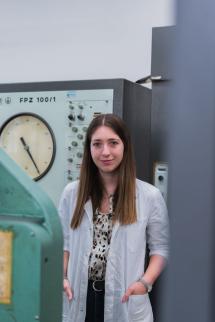 Tell us about yourself:
I am a PhD student at the Department of Glass and Ceramics, where I also completed my bachelor’s and master’s studies. I work in Professor Willi Pabst’s research group on the preparation and effective properties of oxide and silicate ceramics. The results of our work have been published in several papers in impact-factor journals. During my master’s studies I spent a study stay at KU Leuven in Belgium, and during my PhD I did an internship in France thanks to the Barrande Fellowship Programme. I am also working on part of my dissertation at the Institute of Inorganic Chemistry of the Czech Academy of Sciences with Dr. Petr Bezdička, where I focus on X-ray diffraction. Besides research, I try to be active in the academic community. I joined the Electronic Doctoral Signpost (ERD), and I was a member of the UCT Prague Academic Senate for two years, serving as vice-chair for one of them. In the ceramics community I became a member of the President’s Council of Student Advisors (PCSA) of the American Ceramic Society and was elected to the board of the Czech Silicate Society, where I try to support the involvement of young researchers. For several years I have been organising the seminar Inorganic Non-Metallic Materials for PhD students at our department, which connects PhD students working on similar topics across universities. For my research I received the Graduate Excellence in Materials Science (GEMS) award, I was nominated for the Jean-Marie Lehn Prize of the French Embassy, and in 2025 I was selected to attend the prestigious 74th Lindau Nobel Laureate Meeting in Chemistry, where I will have the opportunity to meet Nobel laureates and other talented young scientists from all over the world.
What do you enjoy most about being a scientist?
Mainly that every day is different. Sometimes I read scientific literature, other times I work in the lab, write papers or project proposals, teach students and share my experience with them. I also often spend time in meetings where we deal with what’s happening at the university and try to improve the academic environment. Thanks to research I can travel, meet new people and collaborate with experts from different fields. I like that I’m constantly learning new things and can work on interesting experiments. It’s a great feeling to know that my work contributes to knowledge and that others can now read about it.
What do you consider your greatest achievements so far?
I consider several key moments in my research career to be my greatest achievements. One of the biggest is establishing an international collaboration, writing a proposal and winning the Barrande Fellowship, which allowed me to go on an internship in France. This experience led to publications and a long-term collaboration that continues to this day. I also consider it an achievement that I have managed to combine my doctoral studies with active involvement in the academic community, for example through the Academic Senate and ceramic societies. And of course I greatly value all the awards I have received during my studies, because they motivate me to continue and confirm that I have chosen the right path.
Why did you choose research over industry?
Mainly because of the flexibility and opportunities it offers. I like that research work is varied – it lets me travel, meet experts from all over the world and attend prestigious conferences. Working in the lab is very inspiring for me, because I can keep learning new things and work on innovative projects. I’m also lucky to have a great team in our lab where we help each other, which makes the work even more rewarding. Research offers me opportunities for growth and development that I would probably struggle to find in industry.
What would you say to those considering a PhD at UCT Prague?
UCT Prague supports its PhD students and tries to improve conditions every year so that they feel like full-fledged employees, not just students. It’s a great place to develop not only your research skills but also professionally. Don’t be put off by the occasional demanding period – the effort you put into your PhD is definitely worth it. But keep in mind that it’s important to choose carefully the research group you’ll be working in. Ask before you start what opportunities you’ll have and what will be expected of you, so that your PhD runs as smoothly as possible and you finish on time. If you enjoy lab work, like flexibility and aren’t afraid to go abroad, a PhD at UCT Prague could be a great choice for you.
What impact do you hope your work in the Academic Senate and the Electronic Doctoral Signpost will have on the academic community?
I would like my work in the Academic Senate and the Electronic Doctoral Signpost to help improve conditions for PhD students. I’d like students to feel better informed about everything that’s happening at the university and to have a better overview of what matters to them. I would also like the university environment to be safe and supportive for everyone – a place where every student can feel good and part of the community.