






Tomáš Přibyl
 Tell us about yourself:
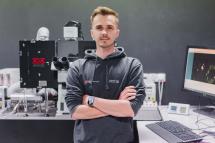
If I had to describe myself in one word, it would be: curiosity. And if I had to add a second word, it would probably be coffee – because without both I wouldn’t be where I am today. I completed the bachelor’s programme Drug Biotechnology and the follow-up master’s programme Clinical Laboratory Diagnostics in Healthcare. I’m now in the second year of the doctoral programme Biochemistry and Bioorganic Chemistry, and at the same time, under the Cotutelle (double-degree) programme, I have started doctoral studies and am in the first year of Molecular and Macromolecular Chemistry at the University of Rennes in France. Since my bachelor’s studies I have been researching new methods of cancer treatment based on molybdenum complexes. I work under the supervision of Assoc. Prof. Jaroslav Zelenka (UCT Prague) and Dr. Kaplan Kirakci (Institute of Inorganic Chemistry of the Czech Academy of Sciences), and I am still actively working in this field.
What do you enjoy most about being a scientist?
What I enjoy most is the freedom – being able to explore whatever comes to mind, find my own way and come up with new ideas. And when something works out, the joy is all the greater. Whether that gives me an answer or just opens up more questions is another matter. Science is an endless process of discovery, and that’s exactly what fascinates me about it.
What do you consider your greatest achievements so far?
I consider my greatest achievement to be the opportunity to study in France under the Cotutelle programme, awarded to me by the French Embassy. I also greatly value the awards I’ve received during my studies – I won the Student Scientific Conference, received the Rector’s Award, placed 2nd in the Crytur Prize for the best master’s thesis, came second in the Julie Hamáčková Prize and made the top 10 theses in the Werner von Siemens Award. Each of these moments motivated me to keep going and confirmed that research is a path that fulfils me.
Why did you choose research over industry?
I always wanted to do something new and not fall into a routine. Research gives me that opportunity – to keep learning, discovering and pushing the boundaries of knowledge. And for me, a PhD is the ticket to what I really want to do in life.
What would you say to those considering a PhD at UCT Prague?
Think carefully about where you want to do your PhD, who your supervisor will be and which lab you’ll work in. Ideally, find out during your master’s studies how things work in the group – it will make your start easier and help you avoid unpleasant surprises. Choosing the right topic and environment plays a key role in whether your PhD will be fulfilling.
What motivated you to apply for the double-degree programme? Is it difficult to combine the requirements of both universities?
I love travelling, and ever since I started at UCT Prague I wanted to go abroad and see how research is done elsewhere. During bachelor’s and master’s studies that’s difficult, so I told myself that I had to go somewhere at least during my PhD. In the end it turned out better than I expected. Thanks to the double-degree programme, I combine cell biology and biochemistry at UCT Prague with molecular chemistry at ISCR in Rennes. This lets me take part in the whole process – from synthesising new molecules through their biological effects to potential applications. I also have supervisors across disciplines – from inorganic and organic chemistry through pharmacy to biochemistry – which gives me a comprehensive view of my research and opens up new possibilities. It’s definitely not easy; the beginning was really tough. Each university has different requirements, administration and ways of working. Sometimes it’s like putting together two different jigsaw puzzles. But precisely because of that, I’ve learned to organise my time better, to be more flexible and to work effectively in a different academic environment. In the end I see it as a challenge that pushes me forward. And living between two countries not only suits me but also brings new opportunities. When you live in a foreign country, you often feel like a tourist and want to explore much more than in your home country.