







Vojtěch Šálek
 Tell us about yourself:
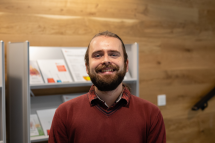
At the end of 2023 I completed my doctoral studies in the Chemical Engineering programme. I’m now trying to gain experience abroad as a postdoc. My PhD focused on fire modelling. Fires may not sound like a typical focus for a chemist, but it’s a wonderful multidisciplinary field that combines knowledge of chemical engineering, chemistry, mathematics, programming, engineering, physics and more. Outside my studies I was very active in the student community – I was a member of two academic senates and of the Tutors association, helped organise orientation courses for new students and promoted chemistry at secondary schools, open days, fairs and similar events.
What do you enjoy most about being a scientist?
To be honest, the opportunity to teach. I feel there are few more meaningful activities than investing time in the development of young (and much more talented) students. As for research itself, I enjoy that every day I try to find solutions to problems that haven’t been solved yet. In doing so, I’m constantly learning from decades and centuries of knowledge of the brightest minds in their fields.
What do you consider your greatest achievements so far?
That I’m healthy and have a well-functioning family. That’s probably not what the question is aiming at, but it’s good to remind ourselves. Simply finishing your studies and still wanting to continue in your field is already an achievement, and I managed that. Along the way I collected the Rector’s Award and two degrees with honours, and I hope I was useful to the university in my free time too, for example through work on various committees, working groups, student associations and at the Counselling and Career Centre. Being surrounded by and able to work with other university representatives who also want to move things forward is perhaps the most valuable experience.
Why did you choose research over industry?
I had no experience with either. But I felt that once I left research, it would be very hard to come back if I found that industry wasn’t for me. Leaving research, on the other hand, is something I think I can still do now. I’m still not sure. I’ll try to continue in research, and if I’m not up to it, hopefully I’ll find another useful role.
What would you say to those considering a PhD at UCT Prague?
That a PhD is a unique opportunity to take several years almost exclusively for developing your own skills and knowledge. It’s an enormous luxury, and I’m grateful to everyone who accompanied me before and during my PhD. Maybe you’ll be grateful too. If you’re still undecided but enjoyed your studies, give a PhD a chance. Nobody says you have to finish it. We’re all different, and I think it’s perfectly fine to realise during your studies that your happiness probably lies elsewhere. You won’t know unless you try.
What role do you think tutors and advisors play in supporting students during their studies?
I can’t comment on the Tutors, the UCT Prague student association – at the time of my PhD they focused exclusively on younger students. If we’re talking about advisors, supervisors, mentors and the like in general, their role is absolutely enormous. Working with the right people is far more important than the topic of your PhD itself. The people around you are what can make you a good scientist, make you enjoy your PhD, keep you motivated in the long term, help you achieve good results and grow and improve. Definitely make time to meet a mentor, and insist on regular consultations with your supervisor or advisor. It will move you forward.