

Interviews with PhD candidates
In considering the comprehensive perspective necessary for the success of our project, we turned our attention to a crucial stakeholder group: PhD candidates. Recognizing their significance, particularly those with experience in or currently working in the private sector, interviews were conducted with a cohort of PhD candidates. This initiative not only shed light on their unique insights but also inspired the conception of a survey to be conducted subsequently at UCT Prague. The survey aims to display the sentiments of the university's community on onboarding, gather their experiences, and assess their openness to the implementation of onboarding practices.
A pilot phase was initiated in in 2023. This phase is instrumental in testing and refining the onboarding process before full-scale implementation. Before delving into the detailed analysis of each step, it is noteworthy to highlight insights gained conversations with the PhD candidates at UCT, Prague. Predominantly, three recurring themes emerged:
- Information Overload on the First Day: Respondents expressed concern about the excessive amount of information presented on the first day of onboarding, indicating a need for a more structured and manageable introduction.
- Desire for Manuals or 'Survival Guides': PhD candidates expressed a desire for concise manuals, akin to what has been termed a 'survival guide' at UCT Prague. A basic set of 15 points outlining essential tasks and resources would be welcomed.
- Language Courses for Foreigners: Particularly concerning foreign candidates, there was a consensus that language courses, ideally conducted before the commencement of the position, would greatly benefit their integration into the academic environment.
These findings underscore the importance of incorporating the perspectives of PhD candidates, as their experiences will play a pivotal role in shaping the subsequent phases of the onboarding process.
UCT Prague Survey on Onboarding
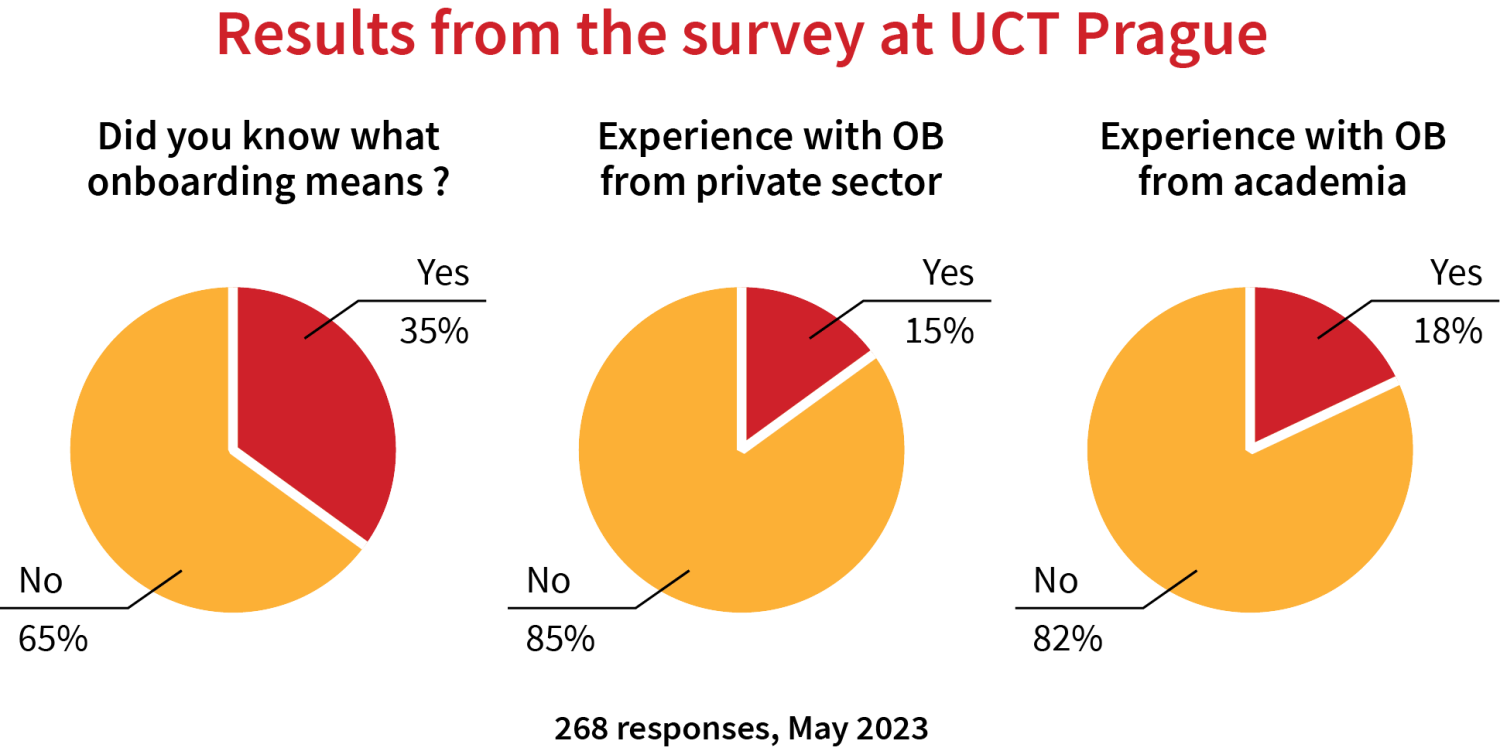
In May 2023, a comprehensive survey was carried out in UCT Prague, garnering insights from 268 respondents comprising both PhD candidates and employees. Notably, a significant proportion of the participants were individuals who had recently joined UCT within the past few years. This deliberate inclusion ensured that the respondents possessed recent and vivid recollections of their onboarding experiences, enabling them to identify aspects that may have been lacking and offer constructive feedback. The wealth of input from these individuals, with their firsthand perspectives on the onboarding process, is invaluable as we strive to refine and enhance our approach to meet the evolving needs of our university community.
Within the confines of the questionnaire, we endeavored to show the familiarity and experiential background of our participants with the onboarding process. A pivotal question sought to ascertain whether respondents possessed an understanding of the concept of onboarding and if they had prior experience with it, outlining between the academic and private sectors. The results unveiled a notable discrepancy, with merely 35% of respondents professing comprehension of onboarding. Delving deeper into their experiences, the subsequent pie charts revealed that a mere 15% of participants had firsthand exposure to onboarding in the private sector, whereas a slightly higher proportion, accounting for 18%, had encountered onboarding within the academic realm. These findings underscore the imperative for a more widespread awareness and appreciation of onboarding practices, necessitating focused efforts to bridge the knowledge gap among our university community.
A critical aspect of our investigation revolved around the insights and recommendations derived from the survey. Within the questionnaire, we incorporated an open-ended inquiry: "Which information would you have welcomed when starting at UCT, Prague?" The wealth of responses received was systematically analyzed, with an effort made to categorize them based on their thematic content. Several recurring answers surfaced, encompassing diverse facets such as administration, financing, departmental information, study duties, evaluation processes, publishing guidelines, and opportunities for securing grants. Noteworthy sentiments were expressed regarding the perceived absence of manuals, a desire for additional educational resources, and aspirations for career growth, aligning seamlessly with the ongoing discourse on doctoral education. Furthermore, the survey participants articulated a demand for courses addressing transferable skills, signaling a contemporary interest in the academic community. These recommendations from the respondents illuminate valuable areas for refinement and development in the onboarding process at UCT, Prague.
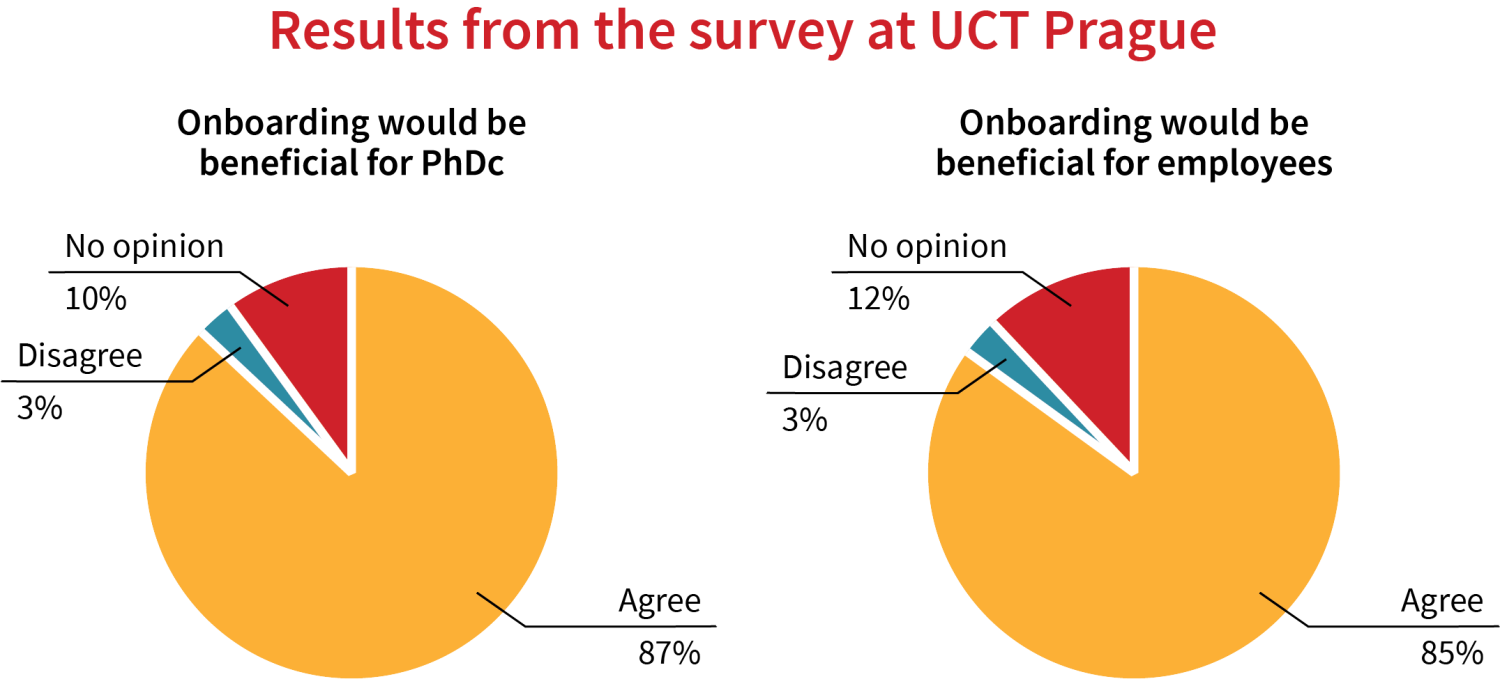
A particularly intriguing set of visuals in our analysis is represented by the two pie charts, revealing a consensus among the majority that onboarding would be advantageous for both doctoral candidates and employees in academia. The overwhelming sentiment expressed in these charts underscores the perceived benefits of effective onboarding practices within the academic context, emphasizing its potential positive impact on the experiences of both doctoral candidates and university employees.
A particularly intriguing set of visuals in our analysis is represented by the two pie charts, revealing a consensus among the majority that onboarding would be advantageous for both doctoral candidates and employees in academia. The overwhelming sentiment expressed in these charts underscores the perceived benefits of effective onboarding practices within the academic context, emphasizing its potential positive impact on the experiences of both doctoral candidates and university employees.
Drawing insights from the questionnaire, along with perspectives gathered from the private sector and interviews with PhD candidates, we have come to the conclusion that we should launch the pilot of the adaptation plan as soon as possible. At UCT, Prague we have collaboratively devised a comprehensive onboarding plan for a year-long pilot program. Our proactive engagement with PhD candidates has resulted in the creation of a "UCT survival guide" tailored for incoming doctoral candidates. This guide serves as a concise resource, offering guidance on where to seek assistance, whom to contact in times of need, navigating specific information, and locating resources on the doctoral study website. As part of the initiative, we are set to conduct an online webinar titled "Freshmen at PhD" each September. This webinar will facilitate a dialogue between newly enrolled and current doctoral candidates, with the latter imparting insights into the expectations, potential challenges, and fundamental aspects of funding within the doctoral program. The entire seminar will be recorded and subsequently made accessible on the doctoral study website.
Furthermore, in contrast to traditional academic onboarding practices, piloting of an adaptation plan inspired by successful strategies in the private sector started. Our focus primarily revolves around the initial meeting between the doctoral candidate and their supervisor, wherein mutual expectations will be discussed, and the new PhD candidate will have the opportunity to pose any queries. Subsequent assessment meetings at the first, third, and sixth months will be integral to display the progress and adapting the onboarding process as needed. After a year-long implementation, a conclusive final meeting will be convened to comprehensively conclude the pilot onboarding process, paving the way for refined practices in the future.