

Information regarding the amendment to the Higher education act
Common information for all candidates
Information regarding the amendment to the Higher education act
As of March 1, 2025, an amendment to the Higher Education Act has come into effect, with most of the changes in doctoral studies becoming effective on September 1, 2025. At UCT Prague, the implementation of changes related to doctoral studies that are not bound by current valid accreditations will take place from September 1, 2025. The amendment primarily concerns newly admitted doctoral candidates, while current doctoral candidates will continue under the same conditions and with the same set of obligations that applied at the time of their admission.
Until the academic year 2028/2029, when most current doctoral study programs will be newly accredited, UCT Prague will operate under a transitional period. During this time, existing accreditations will remain in effect, and certain obligations will be retained.
Main changes for candidates enrolled before 01. 09. 2025
· Doctoral studies will continue to be bound by the rules valid at the time of candidate’s enrolment, i.e. before the amendment. Namely, the following obligation will be kept: English conference at UCT Prague, the basic part of the State Doctoral Exam (SDZ) and foreign stay.
· Above and beyond what the amendment required, UCT Prague has pledged to provide the guaranteed income of 1.2times the minimal wage even to candidates enrolled before 01.09.2025 (for more, see Finances).
Main changes for candidates enrolled after 01. 09. 2025
· Guaranteed income of 1.2times the minimal wage (for more, see Finances site).
· The basic part of the State Doctoral Examination (SDZ) is cancelled, PhD studies are ended with the defence of the dissertation thesis with a discussion.
· Instead of 3 years, doctoral studies can be newly extended at maximum by one year on top of the standard length (3 to 4 years, depending on the accreditation of each DSP).
· Instead of four elective subjects in the Individual Study Plan (ISP), doctoral candidates will complete a mandatory Dissertation Colloquium 1 (Kv1) and three elective specialized subjects according to the demands of Doctoral Degree Board. The exams for these three specialized subjects can be taken separately (a total of three exams) or selected core areas directly related to the dissertation can be assessed collectively during the scientific discussion in Colloquium 2 (Kv2).
· In addition to the three obligatorily-elective specialized subjects and the mandatory Doctoral Colloquium 1, the ISP will include the following obligations:
o Doctoral Colloquium 2 (Kv2)
o Participation in a Student English-language scientific conference (with an alternative option of fulfilling this requirement through an English presentation at Kv2 or at an international conference).
o Completion of an international experience in the form of a minimum 30-day stay abroad (which can be composed of shorter stays or other forms of international cooperation as defined by the internal standard regulating PhD studies).
o A plan of steps for the research work for the dissertation is supplemented for each year of study.
o It is possible to add to the ISP a plan for acquiring pedagogical competencies for doctoral students for the 1st – 4th year, and it is also possible to add to the ISP specific forms of supplementing theoretical preparation or soft-skills.
Doctoral Colloquium 1 (Kv1), obligatory subject – recommended form:
· A ca 10-minute presentation summarizing key points of the dissertation (literature review, methodology, objectives).
· Followed by a scientific discussion on the dissertation topic (20–30 min).
· Held ca in February of the first year of study, no later than six months after the start of the program.
Doctoral Colloquium 2 (Kv2), obligatory milestone – recommended form:
· A ca 10-minute presentation (optional in English according to the Doctoral Degree Board demands) summarizing dissertation progress: two years of research work, summary of results, and plan for the next two years, including the international stay.
· Ca 20–30 minute discussion focusing on the dissertation topic and (alternatively) verification of knowledge from the specialized subjects determined at Kv1.
· Usually completed by the end of the second year of the doctoral study program (20th–24th month of study).
Conclusion
The new doctoral regulations reflect an effort to streamline the study process, promote a more individualized approach, and enhance support for doctoral research and education. These changes also aim to improve international competitiveness.
All planned changes have been approved by the UCT Prague Internal Evaluation Board (RVH), all Doctoral Degree Boards, and the Academic Senate of UCT Prague before implementation.
Common information for all candidates
The rights and obligations of students at the University of Chemistry and Technology, Prague can generally be found in Articles 3 – 5 of the Study and Examination Regulations (SZŘ). For a more detailed overview of the rights and obligations of doctoral candidates at UCT Prague, please refer to Article 9 and Section VI of the SZŘ and in more detail to the internal standard Rules of Doctoral Studies at UCT Prague. All regulations will be available in the documents section.
Working Hours
In the case of full-time attendance-based doctoral studies, a doctoral candidate in the Doctoral Study Program (DSP) at UCT Prague is expected to dedicate 40 hours per week to their studies and activities related to their dissertation project, unless otherwise agreed upon with their supervisor. Doctoral candidates have the opportunity to apply for a stipend from UCT Prague's funds, its faculties, DSP providers, or other sources.
A doctoral candidate is entitled to 30 working days of vacation during the academic year, subject to approval from their supervisor and with the option to carry over unused vacation days or portions thereof to the following academic year.
Attendance records, whether for the doctoral candidate or colleagues, can be monitored in the Infsys system (Attendance Recording or Presence Verification). Leave, personal days off, or study-related absences (such as work conducted outside the school premises) should be recorded in the OKBase system in the case of employment.
Access to UCT Prague's buildings is possible on weekends, public holidays, and during nighttime hours. However, doctoral candidates must inform the receptionist and provide written approval from the head of the respective department to do so.
Changes During the Course of Study
Change of Supervisor
When changing a supervisor, it is necessary to reach an agreement with both the current and the newly proposed supervisor. If both parties agree, the doctoral candidate submits a request to the dean's office of the respective faculty, which is then confirmed by the current and the newly proposed supervisor, the head of the department, and finally the dean of the faculty. The request and further information are available at the faculty's dean's office.
Change of Dissertation Topic
A change of the dissertation topic should ideally occur within two years of starting the DSP. However, minor adjustments or refinements to the topic can be made later during the writing of the dissertation. To change the topic, a request must be submitted, available again at the dean's office in the student affairs office. When requesting a change, besides the old and new topics, the reason for the change should be included. The supervisor, the head of the supervising department, the Doctoral Study Board and the Dean then provide their opinion on the change.
Change of Study Form
A full-time doctoral candidate, whose standard study duration has expired and who has not yet completed their studies, can request to transfer to part-time study, or if their studies are completed (Article 14, Paragraph 2 of the SZŘ - see the documents section). The decision to transfer studies from full-time to part-time is made by the dean based on a well-reasoned written request from the doctoral candidate. Request for Transfer from Full-Time to Part-Time Study (see the documents section).
Study Suspension
The decision to suspend studies is made by the dean based on a well-reasoned written request from the doctoral candidate. Reasons for study suspension by the doctoral candidate include, but are not limited to:
· Health reasons,
· Social and economic reasons
· Pregnancy, childbirth, or parentship
· Representing the Czech Republic in a sport or preparing for such representation
· Other serious personal or family-related reasons,
· Cases deserving special attention
The maximum total duration of study suspension is the time that, when combined with the actual study duration, does not exceed the limit of the maximum study duration. In the case of a doctoral candidate, study suspension can be granted at any point during the study after submitting the study report, with feedback from the supervisor and the head of the educational department. Feedback from the supervisor and the head of the educational department is not required for a request for study suspension due to reasons listed in Article 12, Paragraph 2, Letters a) and c). For more details, refer to Article 12 of the SZŘ. Study suspension during the standard study duration reduces the period of stipend payments. The standard study duration is not extended by the duration of study suspension, except for study suspensions according to Article 12, Paragraph 6 and 13 of the SZŘ (health reasons and parenthood - see the documents section).
Request for Study Suspension/Termination (see the documents section)
For additional information, please refer to the study regulations, the student affairs offices of the DSP, and the documents section.
Information for candidates enrolled after 01.09.2025
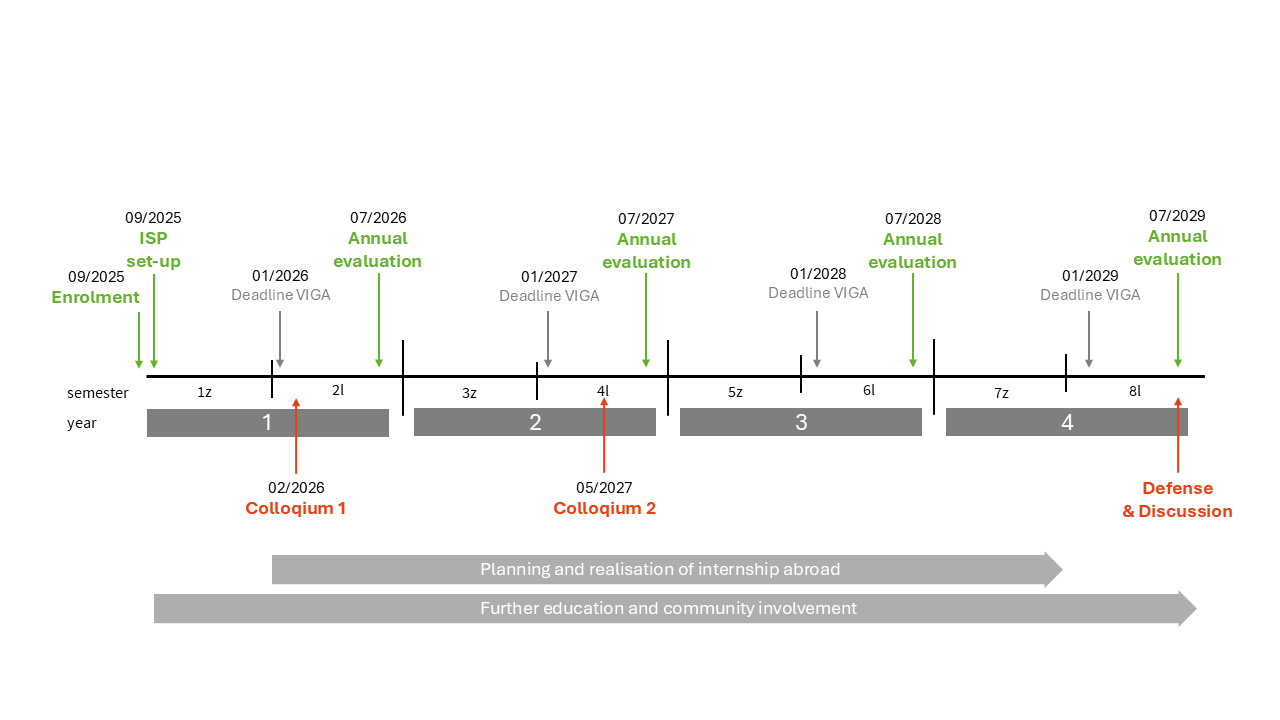
Doctoral studies timeline for candidates enrolled after 01.09.2025 (example)
Study content
Doctoral studies are conducted under the guidance of a supervisor, always according to an individual study plan (ISP) approved by the Doctoral Study Board and the Dean. The ISP prescribes the study subjects, sets the dates for taking exams, specifies the topic for the systematic solution of a specific scientific task in the field of research or development, which is to be completed by preparing and defending a doctoral thesis. ISP can contain steps planned for particular study years. The ISP may also prescribe further domestic and foreign studies and obligation to complete a foreign internship (gaining foreign experience).
Upon agreement with the supervisor and the head of the department, doctoral candidates can also voluntarily participate in pedagogical activities at UCT Prague. The workload related to educational activities (such as leading exercises, laboratories, advising bachelor's and master's theses) must be carefully determined by the doctoral candidate after consulting with their supervisor, considering the demands of their doctoral projects.
Length of study
The standard duration of doctoral studies is a minimum of three years and a maximum of four years, as determined in the decision on the accreditation of the Doctoral Study Program (DSP). The maximum duration of doctoral studies in DSP can be extended by one year. However, during such extension, the candidate loses eligibility for a stipend, and their full-time studies are changed to part-time studies. The time during which a doctoral candidate's studies were interrupted for reasons outlined in Article 12, Paragraph 6 of the Study and Examination Regulations (SZŘ), such as health-related reasons or parenthood (please refer to the documents section for precise details), is not counted towards the standard or maximum study duration. There are currently no restrictions on the validity period of completed examinations in the existing regulations.
Conditions of Doctoral Degree Boards
Each faculty and Doctoral Degree Board has its specific conditions and requirements for studying. You can find them in the documents section at the bottom of this page or in the info box.
Study obligations (not necessarily in order of completion)
- Selection of subject in the ISP
- Together with your supervisor, select at least 3 subject and log them in the ISP in the Study Information System (SIS).
- Different Doctoral Degree Borads have different requirements as for the number of subject in module A and B (see the requirements).
III. Before putting the subject to your ISP, ask the lecturer for details. Doctoral subjects may not be taught every academic year and the schedule may differ from the organization of the academic year at UCT Prague.
- The fourth subject is always Colloquium 1.
- Fulfilment of subjects (typically 4) as specified in the approved Individual Study Plan (ISP). The candidate demonstrates the completion of the study part of the ISP by:
- passing exams, with the results recorded by the examiners in the study report ("passed" or "failed") or
- During Colloquium 2 based on questions outlined during the Colloquium 1.
- Fulfilment of the requirements set by the doctoral degree board (as mentioned in the previous paragraph).
- In general, to be eligible for the defence of a doctoral thesis, it is necessary to submit a list of at least two co-authored articles, in peer-reviewed, impact-factor journals (as specified by the requirements of individual boards).
- It is required to continuously or at the beginning of the calendar year (no later than the end of February) input all publication activities into the electronic database of research, experimental development, and innovation results (OBD). Each doctoral candidate must inquire whether they need to enter the results into the OBD system themselves or if a designated person in their department is responsible for this task.
- English Conference
- Every doctoral candidate in DSP is required to participate in a scientific conference for doctoral candidates at UCT Prague during their studies, typically by the end of the second year, and deliver a professional presentation in English.
- The professional and language level of the presentation and discussion is evaluated by a committee appointed by the dean. In case of a "failed" evaluation, a doctoral candidate may retake the requirement no sooner than 4 months later, and a maximum of one retake is allowed.
- The specific date and application requirements for the professional presentation are determined and adjusted by each faculty separately. You can find the application form in the documents section, or you can inquire at your faculty's dean's office for details.
- Some doctoral degree boards allow for some DSP to pass this obligation alternatively by:
- English presentation at Colloquium 2, or
- English presentation (typically at least 10 min) at an international conference.
- For more information regarding the alternatives to English conference, please refer to the dean’s office or the doctoral degree board. General information is outlined in the doctoral degree board requirements.
- Colloquiums (typically)
- Colloquium 1:
- At the end of winter semester of the 1st year (5th to 6th month of studies)
- Ca 10 min presentation (review, methodology, motivation, aims)
- Ca 20 – 30 min expert discussion aiming at evaluating entry-level knowledge and readiness to solve the dissertation, providing feedback and recommendation to both the candidate and their supervisor.
- Possibility to adjusting/amending the ISP.
- Colloquium 2:
- At the end of summer semester of the 2nd year (20th to 24th month of studies)
- Ca 10 min presentation (possibly in English as per board requirements) summarizing the 2-year progress in solving the dissertation and plans for the next 2 years as well as for the foreign stay.
- Ca 20 – 30 min expert discussion
- Alternatively extended by examination in the three areas outlined during Colloquium 1.
- Foreign internship/experience.
- An integral part of the study obligations is the completion of a study stay at a foreign institution for a minimum of 30 days. This requirement can also be fulfilled through a series of shorter professional stays, the durations of which are cumulative. If the stay is longer than 30 days, all days (incl. weekends) are counted. If the stays are shorter, only days of expert work (e.g. conference days) are counted.
- This study obligation can also be fulfilled by direct participation in an international project or work in an international research group, if the results are published in English in an international periodical indexed in the WoS or Scopus database.
- The study may include voluntary pedagogical activities of doctoral students. The conditions of pedagogical activities of doctoral candidates are regulated by Appendix No. 2 of the internal standards for doctoral studies and are further regulated by decrees of the rector and the relevant dean (see the documents section at the bottom of the page). For more information, see the Pedagogy page.
- The fulfilment of all study obligations and the obtained results (such as publications, patents, conference participation, etc.) are entered annually into the e-doctorand system as part of the annual evaluation.
- At the end of each academic year (no later than 30 days before the end of the current academic year), a doctoral candidate is required to submit an annual report to their supervisor through the e-doctorand module.
- Attention! The point-based evaluation affects the amount of the stipend received, so it is important to pay attention to filling out this form and to attend to the prescribed activities and obligations throughout the year. A complete overview of the point-based evaluation and general guidelines can be found here.
- Failure to meet the deadline results in a point-based evaluation of 0 for the doctoral candidate, and the matter is further addressed with the supervisor and the Vice-Dean for Research and Development of the respective faculty.
Diagram
Information for candidates enrolled before 01.09.2025
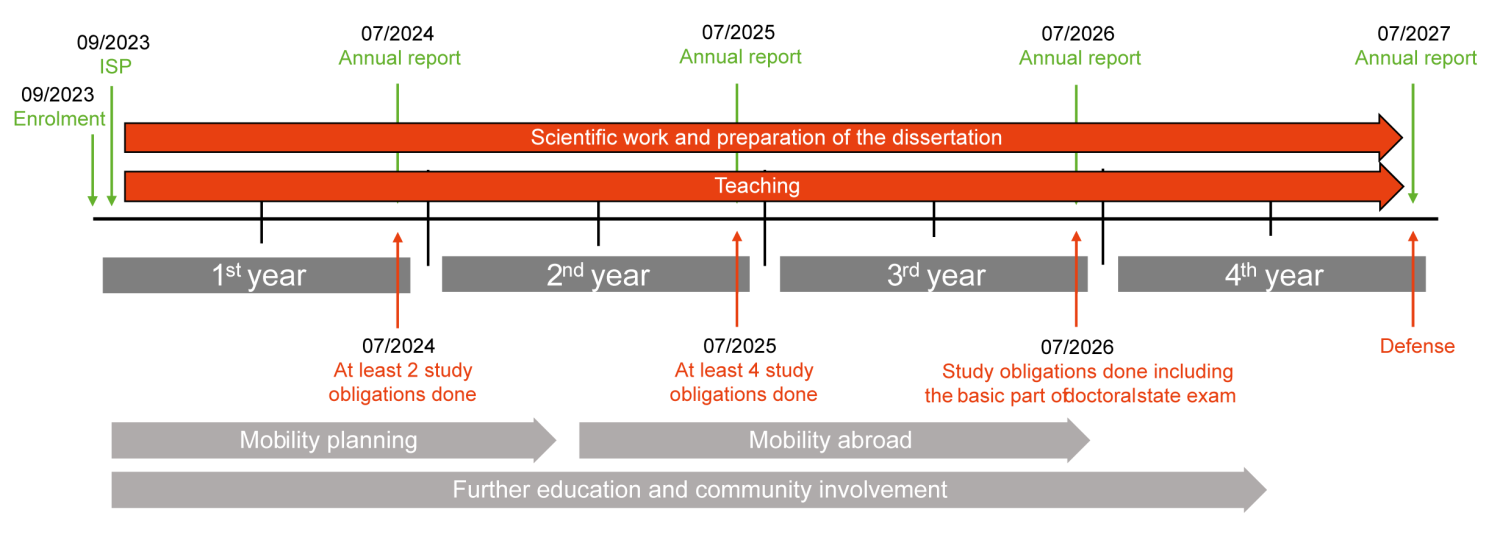
Doctoral studies timeline for candidates enrolled before 01.09.2025 (example)
Study Content
Doctoral studies are conducted under the guidance of a supervisor, always according to an individual study plan (ISP) approved by the Doctoral Study Board and the Dean. The ISP prescribes the study subjects, sets the dates for taking exams, specifies the topic for the systematic solution of a specific scientific task in the field of research or development, which is to be completed by preparing and defending a doctoral thesis. ISP can contain steps planned for particular study years. It also outlines at least three thematic areas of the comprehensive part of the state doctoral examination (for more information, please see the Completion of doctoral studies). The ISP may also prescribe further domestic and foreign studies. The accreditation furthermore prescribes the obligation to complete a foreign internship (gaining foreign experience).
Upon agreement with the supervisor and the head of the department, doctoral candidates can also voluntarily participate in pedagogical activities at UCT Prague. The workload related to educational activities (such as leading exercises, laboratories, advising bachelor's and master's theses) must be carefully determined by the doctoral candidate after consulting with their supervisor, considering the demands of their doctoral projects.
Length of Study
The standard duration of doctoral studies is a minimum of three years and a maximum of four years, as determined in the decision on the accreditation of the Doctoral Study Program (DSP). The maximum duration of doctoral studies in DSP can be extended by three years. However, during this extension, the doctoral candidate loses eligibility for a stipend, and their full-time studies are changed to part-time studies. The time during which a doctoral candidate's studies were interrupted for reasons outlined in Article 12, Paragraph 6 of the Study and Examination Regulations (SZŘ), such as health-related reasons or parenthood (please refer to the documents section for precise details), is not counted towards the standard or maximum study duration. There are currently no restrictions on the validity period of completed examinations in the existing regulations.
Conditions of Doctoral Degree Boards
Each faculty and Doctoral Degree Board has its specific conditions and requirements for studying. You can find them in the documents section at the bottom of this page or in the info box.
Study Obligations
- Fulfilment of subjects (typically 4) as specified in the approved Individual Study Plan (ISP). The selection of subjects may vary depending on the study programs. A doctoral candidate in the Doctoral Study Program (DSP) demonstrates the completion of the study part of the ISP by passing exams, with the results recorded by the examiners in the study report ("passed" or "failed"). Before putting the subject to your ISP, ask the lecturer for details. Doctoral subjects may not be taught every academic year and the schedule may differ from the organization of the academic year at UCT Prague.
- Fulfilment of the requirements set by the department study board (as mentioned in the previous paragraph).
- In general, to be eligible for the defence of a doctoral thesis, it is necessary to submit a list of at least two co-authored articles, preferably in peer-reviewed, impact-factor journals (as specified by the requirements of individual department councils).
- It is required to continuously or at the beginning of the calendar year (no later than the end of February) input all publication activities into the electronic database of research, experimental development, and innovation results (OBD). Each doctoral candidate must inquire whether they need to enter the results into the OBD system themselves or if a designated person in their department is responsible for this task.
- English Conference
- Every doctoral candidate in the Doctoral Study Program (DSP) is required to participate in a scientific conference for doctoral candidates at UCT Prague during their studies, typically by the end of the second year, and deliver a professional presentation in English.
- The professional and language level of the presentation and discussion is evaluated by a committee appointed by the dean. In case of a "failed" evaluation, a doctoral candidate may retake the requirement no sooner than 4 months later, and a maximum of one retake is allowed.
- The specific date and application requirements for the professional presentation are determined and adjusted by each faculty separately. You can find the application form in the documents section, or you can inquire at your faculty's dean's office for details.
- Some doctoral degree boards allow for some DSP to pass this obligation alternatively by presentation in English (typically at least 10 min) at an international conference.
- For more information regarding the alternatives to English conference, please refer to the dean’s office or the doctoral degree board. General information is outlined in the doctoral degree board requirements.
- Basic part of the State Doctoral Exam
- The core, or basic, part of the state doctoral examination (SDZ) is a theoretical oral examination that assesses the doctoral candidate's knowledge of specialized subjects. This part of the examination is typically taken in the year preceding the defence of the doctoral thesis (usually in the 3rd year of study).
- The core part consists of three thematic areas, which the doctoral candidate selects in agreement with their supervisor and in line with their Individual Study Plan (ISP). Thematic areas need to be specified both when filling out the assessment in the e-doctorand system (typically after the 2nd year) and in the application for the core part of the SDZ.
- A doctoral candidate can only take the core part of the SDZ after passing all the exams in the ISP and participating in the English-language conference.
- The application must be endorsed by the supervisor and submitted to the relevant dean's office, which will inform the doctoral candidate of the examination date no later than 1 month before the examination.
- The core part of the SDZ should not exceed a duration of 1 hour, and, with the agreement of the examination committee, it can be conducted in Czech, Slovak, or English.
- The results in each thematic area within the core part of the SDZ and the overall result of the core part, as well as the result of the final part of the SDZ, are expressed as "passed" or "failed."
- The assessment of the SDZ by the examination committee is non-public.
- If the result in one or more thematic areas of the core part of the SDZ is "failed," the overall result of the examination is also "failed," and the doctoral candidate must retake the entire core part of the SDZ. A doctoral candidate has the right to retake the core part of the SDZ only once, but not sooner than 3 months after an unsuccessful attempt. For more information, see the SZŘ internal standard Rules of Doctoral Studies, Article 6 (see the documents section).
- Topics for the state doctoral examinations can be found in SIS (in the detail of a subject "State doctoral examination" for the relevant programme (link to the list in SIS).
- Application for the core part of the SDZ (see the documents section).
- Foreign internship/experience.
- An integral part of the study obligations is the completion of a study stay at a foreign institution for a minimum of 30 days. This requirement can also be fulfilled through a series of shorter professional stays, the durations of which are cumulative. If the stay is longer than 30 days, all days (incl. weekends) are counted. If the stays are shorter, only days of expert work (e.g. conference days) are counted.
- This study obligation can also be fulfilled by direct participation in an international project or work in an international research group, if the results are published in English in an international periodical indexed in the WoS or Scopus database.
- The study may include voluntary pedagogical activities of doctoral students. The conditions of pedagogical activities of doctoral candidates are regulated by Appendix No. 2 of the internal standards for doctoral studies and are further regulated by decrees of the rector and the relevant dean (see the documents section at the bottom of the page). For more information, see the Pedagogy page.
- The fulfilment of all study obligations and the obtained results (such as publications, patents, conference participation, etc.) are entered annually into the e-doctorand system as part of the annual evaluation.
- At the end of each academic year (no later than 30 days before the end of the current academic year), a doctoral candidate is required to submit an annual report to their supervisor through the e-doctorand module.
- Attention! The point-based evaluation affects the amount of the stipend received, so it is important to pay attention to filling out this form and to attend to the prescribed activities and obligations throughout the year. A complete overview of the point-based evaluation and general guidelines can be found here.
- Failure to meet the deadline results in a point-based evaluation of 0 for the doctoral candidate, and the matter is further addressed with the supervisor and the Vice-Dean for Research and Development of the respective faculty.
Diagram

