







Jakub Tomáško
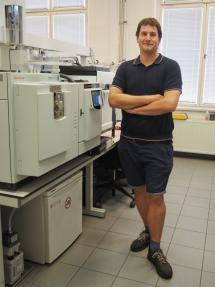 Tell us about yourself:
I am a graduate of the doctoral programme Food Chemistry and Analysis at the Department of Food Analysis and Nutrition, but my work focuses on the analysis of environmental contaminants (mainly chlorinated paraffins), their fate and possible routes into the human body. Food analysis is therefore only part of my professional scope. With friends I also regularly take part in pub quizzes, including the Czech Championship, where my favourite topics are film, history and various logic and word puzzles.
What do you enjoy most about being a scientist?
That you get to tackle new challenges and don’t fall into a routine. A former colleague of mine used to say that the great thing about being a scientist is that something different annoys you every day. That goes hand in hand with solving small problems, where you have to apply your existing knowledge and experience, the scientific method and sometimes manual dexterity when performing experiments. And it is exactly this everyday overcoming of difficulties and discovering something new that is beautiful, because a scientist’s work doesn’t have to be only about big breakthroughs.
What do you consider your greatest achievements so far?
Winning the Zlatý bludišťák. Then taking part in the certification of a reference material for the analysis of chlorinated paraffins in fish. The details are not that important, but in analytical chemistry these materials are very important. The fact that our laboratory was invited to take part confirms – and in a way praises – that our working group is doing well what we do. For me it is also significant because I introduced chlorinated paraffin analysis at our department right from the beginning of my research career. During my studies I also received the AOAC/Herbalife and Emil Votoček scholarships and the Josef Hlávka Award for my research.
Why did you choose research over industry?
As a postdoc I am continuing with topics that either build on studies completed during my PhD or that we didn’t manage to finish. In other words, there is still plenty to do. However, as a young researcher I hope I won’t have one job until retirement, and I wouldn’t rule out industry in the future.
What would you say to those considering a PhD at UCT Prague?
Give it a try and see. Even though it is another level of university study, it is quite different from a bachelor’s or master’s degree, and even someone who scraped through their exams can find their place here and excel. Research teams also need – and give room to – both orderly hard workers and slightly scatterbrained but creative people. As for UCT Prague itself, the advantages of studying here include the fairly luxurious instrumentation of the individual departments, involvement in often very interesting projects, and the opportunity to teach.
How do you see the importance of awards such as those from the Hlávka Foundation in supporting young scientists and students? Could you also tell us about the research for which you received the award?
I value the Hlávka Foundation award very highly, mainly because of its prestige and because of Josef Hlávka himself as a patron of culture and science. That said, I would say that the Internal Grant Agency system for PhD students at UCT Prague is far more important for supporting young researchers. I received the award shortly after completing my PhD, so it was more for my overall results than for a single study. In my PhD I focused on the analysis of chlorinated paraffins, man-made substances used mainly as additives in plastics. They can have negative effects on human health, mainly by disrupting the hormonal system, and are also suspected of being carcinogenic. In my research I monitored the occurrence of these substances in their primary uses (technical mixtures, plastics and textiles), their release into the environment, their entry into food, their behaviour during food processing and, last but not least, their presence in the human body. In short, despite being almost ubiquitous, the exposure of the Czech population to these substances is relatively low.