







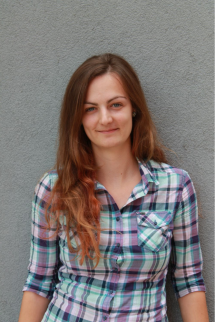
Soňa Vytykáčová
 Tell us about yourself:
At UCT Prague I studied the programme Chemistry and Chemical Technologies, specialising in Inorganic Chemistry. I am now continuing with doctoral studies in Inorganic Chemistry, supervised jointly by the Department of Inorganic Chemistry at UCT Prague and the Institute of Photonics and Electronics of the Czech Academy of Sciences, where I am also employed. During my studies I received the Moser Prize (Student Scientific Conference), the Preciosa award for the Student Scientific Conference, the Preciosa Prize and an Honourable Mention from Crytur for my master’s thesis, and I presented my thesis in the “Diplomky na stojáka” (stand-up thesis presentations) project.
What do you enjoy most about being a scientist?
I enjoy teaching, and I’m glad I had the chance to try it during my PhD. Otherwise, I think a good thing about research work is that you learn to work with different instruments and methods and to interpret diverse data. I enjoy coming up with practical solutions and ways of carrying out experiments – I prefer working in the lab to working at a computer.
What do you consider your greatest achievements so far?
Probably hearing from former students I taught that my lab classes weren’t a complete waste of time :D
Why did you choose research over industry?
I got the opportunity to work at the Czech Academy of Sciences, and I was tempted to try out what research is like. I was also tempted to try teaching, which was possible precisely as part of a PhD.
What would you say to those considering a PhD at UCT Prague?
I think that if someone is tempted to try it, they should go for it. It’s best to start a PhD right after graduating – you’re still used to studying, and you have people around you from your year (or younger years) whom you know. If you know the people around you and know your way around the university’s opportunities (grant applications, extracurricular activities, etc.), it’s always easier. I also think it’s better to start a PhD right after your master’s than to return after a long break. A PhD can be an advantage for those who would like to spend some time abroad, because today there are many opportunities to travel as part of a PhD. Last but not least, if it turns out that doctoral study doesn’t meet your expectations, you can always leave and look for a job elsewhere. But in my opinion it’s always better to try and possibly leave than to regret not trying something you could have done.